
Dawn Hunter's Cajal Artwork Portfolio

Biographical Research through Art
“Any man could, if he were so inclined, be the sculptor of his own brain. ”
- Santiago Ramón y Cajal
Dawn Hunter is a visual artist, Fulbright Scholar, and former Starr Foundation Fellow whose awards recognize her interdisciplinary approach to art and science. She is best known for her extensive work on Santiago Ramón y Cajal, widely regarded as the father of modern neuroscience. Her portfolio, deeply biographical in nature, explores Cajal’s life and contributions, translating historical scientific inquiry into visual form. Developed over several years, this body of work demonstrates Hunter’s ability to bridge disciplines through research-driven practice. This website, part of the Dawn Hunter Art® boutique web network, features her portfolio, Aesthetic Instincts: The Intersection of Art and Science in the Life of Santiago Ramón y Cajal.
Portrait of Dawn Hunter, left.


Who was Santiago Ramón y Cajal?
Ramón y Cajal was a Spanish scientist and the first person to demonstrate that the nervous system was made up of individual units (neurons) that were independent of one another but linked together at points of functional contact called synapses. Ramón y Cajal illustrated the results of his studies with elegant drawings of neurons that he proposed work independently or collectively, and that each individual unit can participate simultaneously in individual or multiple neuron functions. Ramón y Cajal was a 1906 Nobel Laureate in Physiology or Medicine that was awarded jointly to another neuroscientist, Camillo Golgi "in recognition of their work on the structure of the nervous system,” however, their research was mutually exclusive and embraced opposing theses. Santiago Ramón y Cajal is considered by many to be the father of modern neuroscience.
Select Portfolio Highlights of the Artwork
Click on each image to learn more about each drawing or painting.


New Article Published in Sage Journal The Neuroscientist!
Dawn Hunter: "I am honored to have served as the lead author on the article Art, Intuition, and Identity in Ramón y Cajal. This article posits that Cajal’s enduring success is not solely based on his scientific breakthroughs. Equally crucial was his creation of a unique artistic language and his early adoption of self-branding techniques. Cajal skillfully blended classical artistry and emerging photographic techniques to enhance his scientific presentations. His personal narrative, intertwined with objective research, not only captivated fellow scientists but also reached a broader audience. His strategic use of self-portraits and scientific illustrations went beyond mere documentation, enriching the cultural dialogue around science.
Cajal's legacy, therefore, is not confined to his scientific achievements; his influence extends into the realms of art and cultural history, perpetuating the impact of his work on future generations."
Society for Neuroscience
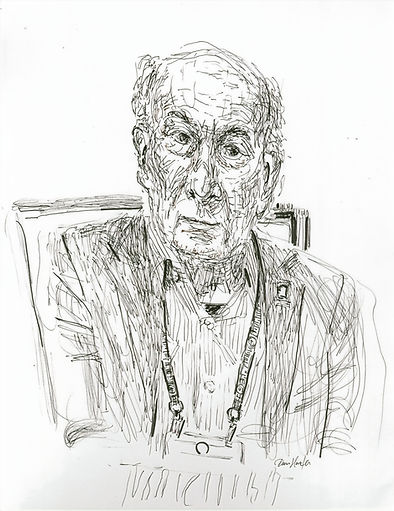
Go behind the scenes and read about Dawn Hunter's process when she drew Pasko Rakic at the annual Cajal Club social.
A portrait drawn from life, capturing a moment of focus and exchange, where drawing becomes a way of seeing and engaging with the process of thought and observation.
Dawn Hunter featured in Q&A with writer Rebecca Horne in leading neuroscience magazine!

"The painter and visual arts professor spent hours recreating Ramón y Cajal’s art and poring over his sketchbooks and self-portraits in the National Archives of Spain, uncovering unappreciated aspects of his techniques and influences."
Featuring the 'Cajal Artwork Portfolio' by artist Dawn Hunter as featured in . . .


